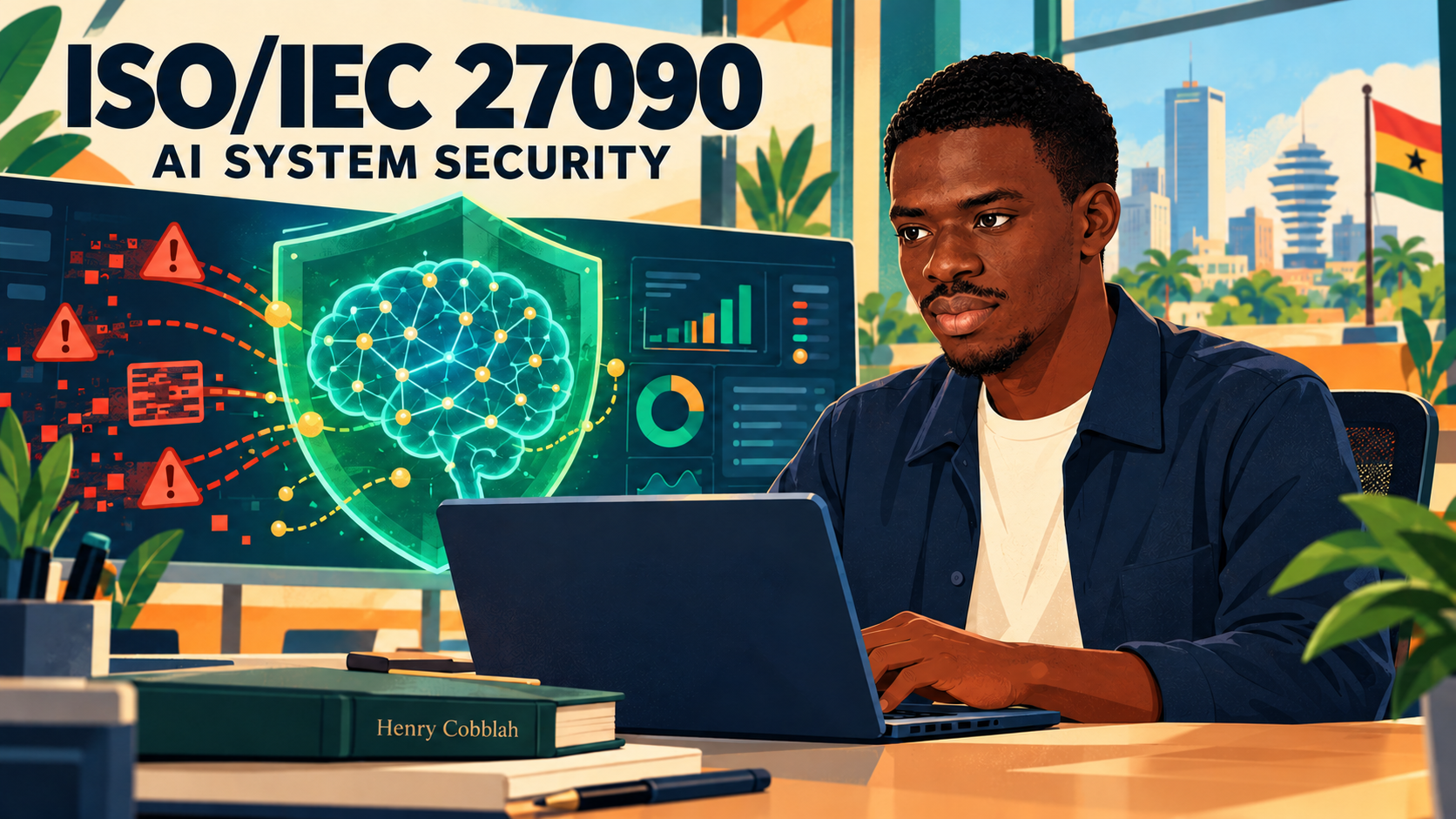



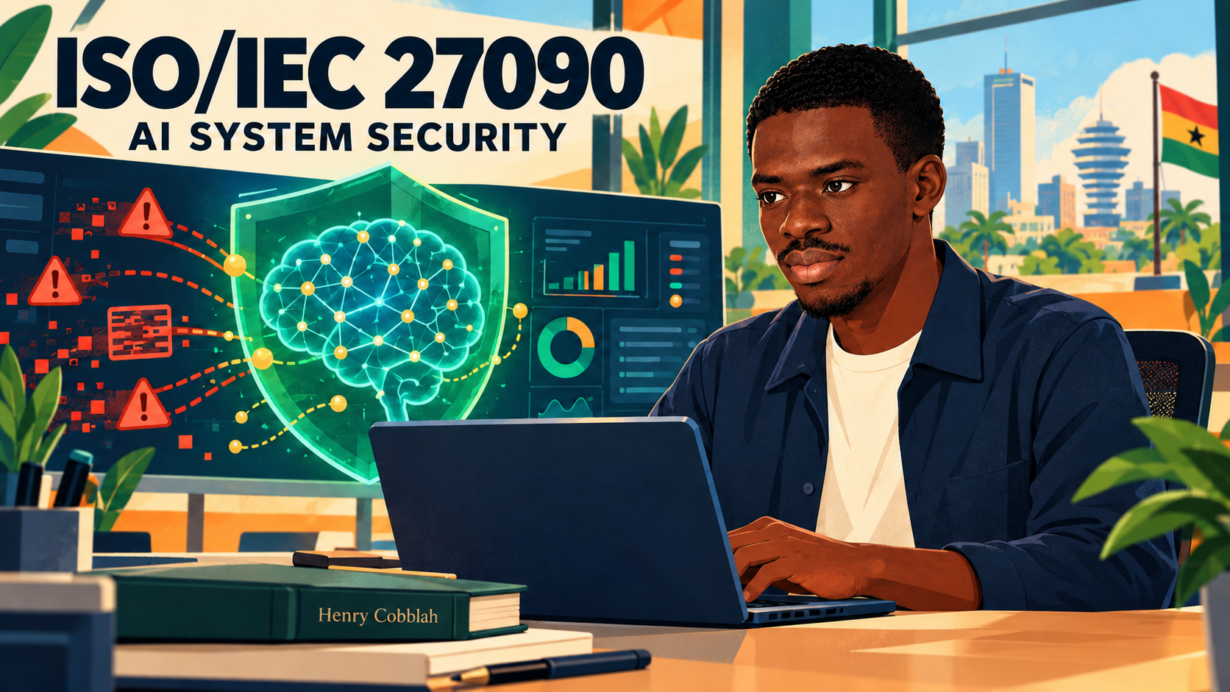

Mercury does not announce itself in the Ankobra. It enters upstream, quietly, and every household downstream drinks it.
That image stayed with me as I read about ISO/IEC 27090, published on 14 October 2026.
As a PECB-certified ISO/IEC 42001 Lead Auditor and Lead Implementer, I spend my days asking organisations whether their AI is governed. 42001 tells you to manage AI risk. 27001 tells you to secure information. Neither tells you what data poisoning or prompt injection actually does to your model. 27090 fills that gap with five threat classes: poisoning, evasion, membership inference and model inversion, model stealing, and prompt and output injection.


It is guidance, not a certificate. Nobody will frame it on a wall. Good. It is meant to be used.
Now bring it home.
On 24 April 2026, President Mahama launched Ghana’s National AI Strategy, naming NITA, the Data Protection Commission and the Cyber Security Authority for implementation. An Emerging Technologies Bill is expected before Parliament by year end. Meanwhile, the laws we actually work with, the Data Protection Act, 2012 (Act 843) and the Cybersecurity Act, 2020 (Act 1038), were written before generative AI walked into our banking halls.
And it has walked in. Banks score credit with models. Fintechs verify KYC with face-matching. Telcos answer customers with chatbots. Much of it arrives inside vendor software, listed on no register.
So, the uncomfortable question. If your fraud model were retrained on poisoned transaction data, would your team even call it an incident? Would your Act 1038 reporting capture it? Who do you call first: the SOC, the data scientist, or the vendor overseas?
My advice to Ghanaian boards, before the Bill arrives:
Build the AI inventory first, including the AI hiding inside your SaaS contracts. You cannot map threats to systems you do not know you run.
Map each system to the five classes inside the risk register you already have. Do not start a parallel programme.
Write AI-specific incident playbooks. You cannot patch a poisoned dataset the way you patch a server.
Ask vendors about these five threats by name. “We take security seriously” is not an answer.
Give AI risk a named owner across security, data, legal, procurement and the business. Undefined ownership is still a decision.
To be fair, 27090 is narrow. It focuses on deliberate attacks on the model. Insider misuse and AI as an attack tool sit largely outside it. It is a lens, not the whole map.
But Ghana has a rare advantage. We are writing our AI rules while adoption is still young. We can test the water before the river is poisoned, not after.
Clean water is cheaper at the source.
Is AI a line item in your risk assessment yet, or still a rumour?