



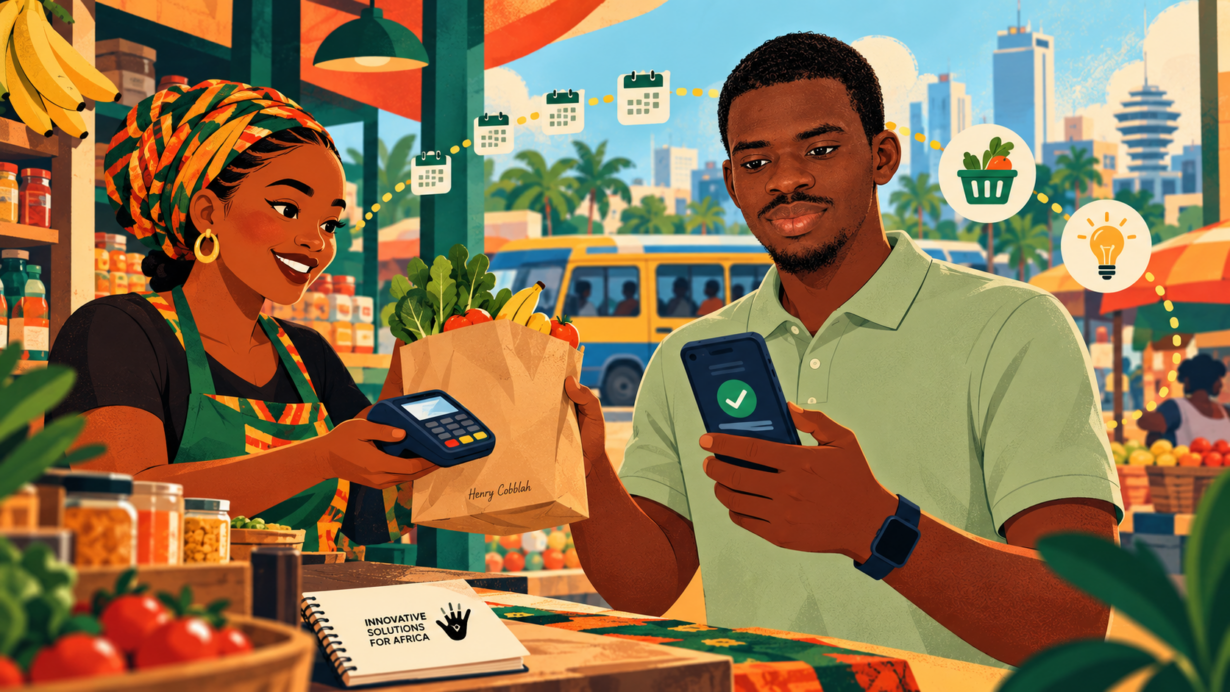

Ghana’s Digital Banking App Leaderboard 2026 — and the design brief hiding inside it
Data as at 1 June 2026 · Google Play Store (Android) · 23 licensed banks operating in Ghana


As mobile banking becomes the primary channel for customer engagement, app performance has become one of the clearest public indicators of customer experience. To understand how Ghana’s banking apps are actually perceived, I compiled Google Play Store data for the licensed banks operating in Ghana and analysed it across four perspectives: rating, downloads, review volume, and performance among Ghana-focused institutions.
The leaderboard itself is the easy part. The harder — and far more useful — question is what the numbers say about how Ghanaians actually use these apps, and what it would take to move a banking app from something you open when you must, to something you open when you wake up.
That is the difference between a transaction tool and a daily financial tool. Right now, almost none of our apps are the second thing.
1. What the data actually says
The sector average is 3.73★ — and the spread is the story
Across all 23 apps, the mean rating is 3.73★, the median 3.70★, with a standard deviation of 0.45 and a range running from 2.7★ to 4.6★. That spread of nearly two full stars between the best and worst experience in the same regulated industry, serving broadly the same customer, is not a rounding difference. It is a strategy difference.
Grouped into bands:
Rating band Banks Share
4.0★ and above 5 22%
3.5★ – 3.9★ 13 57%
Below 3.5★ 5 22%
Over three-quarters of Ghana’s banking apps sit below 4.0★. In consumer app terms, that is the zone where a product is tolerated rather than chosen.
Scale does not buy satisfaction
This is the finding I would put in front of every bank board in Accra. The correlation between install base and rating across the 23 apps is r = 0.13 — statistically indistinguishable from no relationship at all.
The two most-installed apps in the dataset (10M+ each) sit at 4.2★ and 3.6★. A 10K-install app sits at 4.3★. Another 10K-install app sits at 3.1★. Distribution and delight are independent variables. You can win the download race and lose the customer.
Fidelity Bank Ghana is the standout precisely because it refuses that trade-off: 4.6★ at 1M+ installs and 34,434 reviews — the only app in the market holding a top-quartile rating at genuine scale.
Ghana-focused apps are outperforming group apps
Splitting the field between apps built for the Ghanaian market and those inherited from regional or international group platforms:
Ghana-focused apps: 3.92★ average
Regional / group apps: 3.58★ average
A third of a star, consistently, in favour of local product ownership. Group platforms bring engineering muscle, uptime discipline and security budget. What they often cannot bring is a roadmap that answers to a Ghanaian customer’s month — school fees in January, Momo cash-in on a Sunday, a trader reconciling stock at 8pm in Makola. Local product ownership is not sentiment. It is a measurable advantage.
86% of the sector’s feedback comes from two apps
Of 853,038 total reviews across the market, 86% belong to just two apps. Fifteen banks have fewer than 7,000 reviews combined.
This is the metric almost nobody tracks, and it may be the most damaging. Most Ghanaian banks are flying with almost no public feedback signal. They are not receiving fewer complaints — they are receiving fewer observations. You cannot iterate on silence.
Voice density: a 16x spread in engagement
Reviews per 100 installs is a rough but revealing proxy for how emotionally present an app is in a customer’s life. Across the sector it runs from 4.54 down to 0.28 — a 16x spread.
High voice density is not automatically good (frustration writes reviews too), but near-zero voice density is almost always bad. It means the app is being installed to complete one errand and then ignored. Installed, not adopted. That is the honest state of most banking apps in Ghana today.
2. The real benchmark is not another bank
Here is the comparison that reframes everything.
In June 2026, mobile money in Ghana processed 954 million transactions worth GH¢492.9 billion, according to the Bank of Ghana’s Summary of Economic and Financial Data. Registered accounts reached 84.6 million, with 26.4 million active, and float balances hit a record GH¢40 billion. Internet banking, by contrast, recorded around GH¢42 billion in April 2026, and cheques roughly GH¢35.7 billion.
Mobile money is not winning because it is more sophisticated than a banking app. It is winning because it is faster to open, faster to finish, and available at 6am on a Sunday from a trotro seat. It attached itself to daily life. Banking apps attached themselves to banking.
The competitive question for 2026 is therefore not “which bank has the best app?” It is: which bank’s app earns a place in the customer’s morning and evening routine?
3. The design brief: a start-and-close-day financial app
If a banking app is going to become a daily tool, it needs a reason to be opened twice a day — the way people check weather, messages, or a fitness ring.
Open of day — the Financial Morning Brief (under 10 seconds, no login friction for read-only view):
Available-to-spend today, not just account balance — balance minus committed outflows
What is due today and this week: standing orders, loan instalment, insurance, school fees
Yesterday’s spend against the week’s pace, in one line
Any inflow that landed overnight, plus anything that needs action
One clear next action — nothing else
Close of day — the Evening Close (under 30 seconds):
Today’s spend, auto-categorised, with anything unusual flagged
Uncategorised or duplicate charges to confirm or dispute in one tap
Sweep the day’s surplus into savings or a money-market position automatically
Tomorrow’s obligations previewed
A single running figure: are you ahead of or behind your own plan this month?
This is the “start-and-close-day” model. It is not a new feature. It is a new frame — the app as a daily ledger you close, not a counter you visit.
4. Financial management and education, personalised to real income and spend
Generic financial literacy content has almost no effect on behaviour. Personalised, in-context guidance does — because it is about the customer’s own money, on the day it moves.
Personalised financial management should be built on data the bank already holds:
Income rhythm detection. Salaried, commission-based, seasonal, or irregular trader income each require a different budgeting engine. A rigid monthly budget fails a market trader with daily receipts.
Automatic categorisation with local taxonomies. Fuel, MoMo cash-out, school fees, tithes and offerings, remittances, farm inputs, apprentice wages. Off-the-shelf Western categories mislabel Ghanaian spending and destroy trust in the whole feature.
Committed vs. discretionary split. The single most useful number in personal finance is what you can safely spend, not what you have.
Cashflow forecasting. Project the account to the next payday and warn before a shortfall, not after a failed direct debit.
Micro-lessons triggered by real events. When an overdraft fee hits, explain that fee — 90 seconds, in that moment. When a customer holds GH¢8,000 idle in current account for 60 days, explain what the erosion costs them at prevailing inflation. Teach at the point of consequence, not in a content hub nobody opens.
Vernacular options. Twi, Ga, Ewe, Dagbani, Hausa audio explainers for core concepts, and plain-English defaults everywhere else. Financial exclusion in Ghana is often a language problem wearing a product costume.
The measure of success is not content views. It is behaviour change — savings rate, fee avoidance, overdraft frequency, emergency-buffer days.
5. Investments and trades, without turning the app into a casino
Ghana has a real and under-served retail investment appetite: Treasury bills, government bonds, fixed deposits, mutual funds and collective investment schemes, GSE-listed equities, and increasingly diaspora and FX-linked products.
Bringing these into the daily app should follow three rules:
Suitability before product. Profile risk tolerance, time horizon and liquidity need first. Only surface instruments a customer can actually hold responsibly, and be explicit that investment services fall under SEC Ghana licensing and require proper advisory and disclosure standards.
Small, automatic and continuous beats large and occasional. Round-up investing, “sweep the surplus” rules, and GH¢50 minimums do more for wealth formation in Ghana than a GH¢5,000 minimum ever will. Daily engagement makes recurring micro-investing possible; monthly engagement does not.
Show the honest number. Net of fees, net of tax, net of inflation. A T-bill headline yield presented without an inflation-adjusted view is not education — it is marketing.
Personalisation here means matching instruments to the customer’s actual cashflow pattern. A trader with volatile weekly receipts needs liquidity-first products. A salaried professional with a stable surplus can ladder longer tenors. The app already knows which one it is talking to.
6. UI/UX: the usability rules that separate 4.6★ from 3.0★
Having looked at the spread in this dataset, the difference between the top and bottom quartile is rarely feature count. It is friction. Ratings below 3.5★ are almost always earned at these five points:
Time-to-first-value. Balance visible in under three seconds from tap, before full authentication. Biometric login as default, PIN as fallback, passwords as a last resort.
The three-tap rule. Any of the top five journeys — check balance, send money, buy airtime/data, pay a bill, view a statement — completed in three taps or fewer from launch.
Session resilience. Aggressive timeouts and lost form data are the most common complaint in low-rated finance apps anywhere. Preserve state; re-authenticate without restarting the journey.
Honest states. Show pending, failed and reversed clearly, with a reference and an expected resolution time. Ambiguity after a failed transfer is what turns a mild irritation into a one-star review and a branch visit.
Low-bandwidth and low-end device performance. An app that only performs well on a flagship phone on 4G has excluded most of its addressable market. Test on a GH¢800 Android device on 3G. That is the real user.
Accessibility and inclusion belong here too: large-text support, high-contrast mode, screen-reader labelling, and one-handed reachability for the primary actions.
7. Security that enables daily use instead of obstructing it
This is where I want to be very direct, because it is where I spend my professional life.
The Bank of Ghana’s Cyber and Information Security Directive (CISD) 2026 replaced the 2018 framework this year, extending a unified regime across banks, microfinance institutions, fintechs and payment service providers, expanding the role of the Financial Industry Command Security Operations Centre (FICSOC), and — notably — introducing governance requirements for AI and machine-learning systems used in areas such as fraud detection and credit scoring. Governor Dr. Johnson Asiama’s framing at the launch was that a framework built for 2018 cannot solve the problems of 2026.
The instinct in many institutions is to translate a tightened directive into more friction for the customer. That is the wrong translation. Well-designed security is mostly invisible and mostly happens on the bank’s side:
Risk-based, step-up authentication. A GH¢20 airtime top-up to a saved beneficiary on a known device should not demand the same ceremony as a GH¢50,000 transfer to a new account at 2am. Score the risk; challenge only when the score justifies it.
Device binding and behavioural signals. Bind the app to a device and use passive signals — typing cadence, handling patterns, geolocation consistency — so that the common case is frictionless and the anomalous case is caught.
On-device biometrics with secure-enclave key storage, never biometric templates on the server.
Certificate pinning, root/jailbreak and emulator detection, screen-capture blocking on sensitive views, and hardened API gateways with per-endpoint rate limiting.
Customer-controlled security. Let customers set their own transaction limits, lock and unlock channels, freeze a card instantly, and see a live session log of every device signed in. Control reduces anxiety, and anxiety is what stops daily use.
In-app fraud reporting and instant self-service card freeze, reachable in one tap from anywhere in the app.
Alignment to ISO/IEC 27001 as the management-system backbone, so that controls are governed, evidenced and continuously improved rather than assembled per audit cycle.
The principle: security should be heavy behind the glass and light in front of it. A customer who must fight the app to check a balance will simply go back to the MoMo agent.
8. Open APIs: the connection layer that makes daily use possible
No single bank app can be a customer’s whole financial life. Most Ghanaians hold at least one bank account and at least one wallet; many hold several of each. A daily financial app that shows only one institution’s slice is showing an incomplete picture — and incomplete pictures do not earn daily opens.
The regulatory direction is already set. The Bank of Ghana issued a draft Open Banking Directive proposing a shared Open Data Exchange (OpenDX) platform for consent-based data sharing over standardised APIs, and has announced a proof-of-concept phase covering infrastructure readiness, secure API and data standards, third-party accreditation, and a regulatory sandbox. GhIPSS interoperability has already proved the domestic plumbing works at scale — mobile money interoperability alone moved billions of cedis monthly through 2026.
What banks should build toward:
Consent-first account aggregation — bank accounts, MoMo wallets, cards and investments in one view, with granular, revocable, time-bound consent that the customer can audit and withdraw in one tap.
A published developer portal with sandbox, versioned APIs, uptime status page and clear SLAs. In an open-banking market, your API documentation becomes a distribution channel.
Deep merchant and biller integration — utilities, schools, insurers, tax, DVLA, church and association dues — because bill payment is the highest-frequency reason a person opens a finance app.
Embedded finance outward. Let the bank’s rails appear inside the SME accounting tools, POS systems and marketplaces where Ghanaian businesses already work.
Strong API security posture — OAuth 2.0 with mTLS, short-lived scoped tokens, signed requests, comprehensive audit logging, and third-party due diligence proportionate to data sensitivity.
Open APIs shift the customer relationship from ownership of data to usefulness with data. The banks that adapt fastest will be the ones that were never relying on data lock-in to keep customers in the first place.
9. Customer care that lives inside the app
Look again at the review distribution: 86% of feedback concentrated in two apps, and fifteen banks with negligible review counts. A large share of what appears in app store reviews is not a product complaint at all — it is a service complaint that had nowhere else to go.
In-app care should be built as a first-class product surface:
Contextual support. A help request raised from a failed transfer should arrive with the transaction reference, device, app version and error state already attached. Never make a customer re-narrate what the system already knows.
Self-service resolution for the top ten issues — failed transfer status, reversal timelines, PIN reset, limit changes, statement requests, card activation, dispute logging. These are the bulk of contact volume and almost all of them can be automated safely.
Live status transparency. When a channel is down, say so in the app. Silence during an outage generates more one-star reviews than the outage itself.
Published resolution SLAs, visible to the customer, with a case tracker.
A closed feedback loop. Respond to store reviews within 48 hours, and route recurring themes into the product backlog with an owner. Fidelity’s 4.6★ at scale is not an accident of taste; sustained ratings at that level require a functioning listening system.
Escalation to a human that actually works, with context carried across the handoff. AI assistants should reduce time-to-resolution, not become another wall.
Improving in-app care also improves Turn Around Time (TAT) and takes pressure off branch and contact-centre staff. The customer today is in a hurry, and the employee today is stretched. Good digital service serves both.
10. The scorecard banks should actually run
Star ratings are a lagging, noisy indicator. If the goal is a daily financial tool, these are the metrics worth reporting to the board every month:
Metric Why it matters Target direction
DAU / MAU ratio The single best measure of “daily tool” status > 30%
Sessions per active user per week Habit formation, not errand completion > 5
Time-to-balance from app launch Core friction indicator < 3 seconds
Top-5 journey completion rate Where ratings are actually won or lost > 95%
Crash-free session rate Reliability floor > 99.5%
Voice density (reviews per 100 installs) Feedback signal strength Rising, with rating held
% of customers with an active savings or investment position Whether the app builds wealth or only moves money Rising
First-contact resolution in-app Care effectiveness and TAT > 70%
Fraud loss rate per GH¢1m transacted Security effectiveness without friction proxy Falling
Rating trend, 90-day rolling Direction beats snapshot Rising
An institution that moves DAU/MAU from 12% to 30% will see its star rating follow. The reverse — chasing the rating directly — rarely works.
POINTS TO MEDITATE
 Digital excellence goes beyond ratings. True digital leadership depends on security, reliability, uptime, innovation, transaction success rates, and overall customer experience — several of which never surface in a star count.
Banking has moved from long queues to the devices in our hands. The digitally inclined banks have the clearest path to leading the industry.
The competitor is not the bank next door — it is the wallet already open on the customer’s home screen. GH¢492.9 billion moved through mobile money in June 2026 alone. That is the standard for daily financial behaviour in Ghana.
Improve Turn Around Time. The customer today is in a hurry. Moving from paperwork to digital does not only serve the customer — it takes real stress off your employees.
Which Ghanaian bank do you believe is setting the pace in digital banking? And which single feature — daily cashflow view, in-app investing, better security, faster support — would most improve your own banking experience?
Sources: Google Play Store (Android), compiled 1 June 2026; Bank of Ghana Summary of Economic and Financial Data (2026); Bank of Ghana draft Open Banking Directive and Open Banking pilot announcements; Bank of Ghana Cyber and Information Security Directive (CISD) 2026. Analysis and opinions are my own.