


ISO 27090: Ghana Watch!

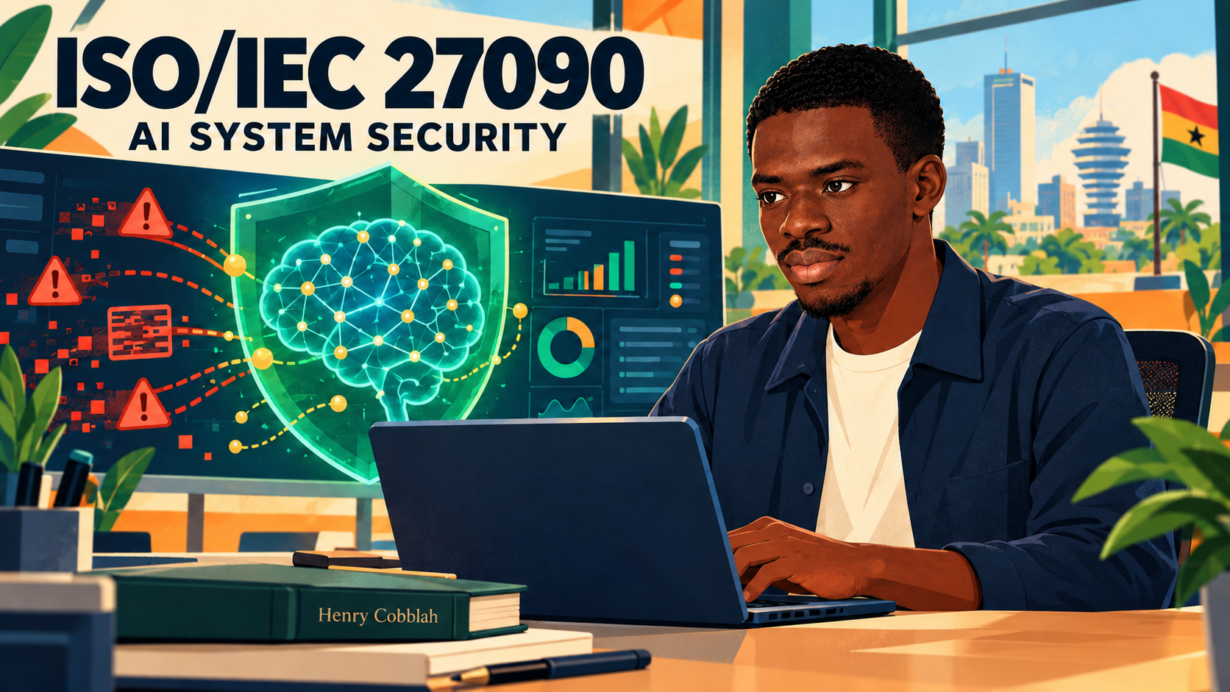
ISO/IEC 27090 highlights the unique threats to AI models such as poisoning and prompt injection, urging Ghanaian organizations to inventory AI uses and embed AI-specific incident responses before regulations and risks escalate.
Share

Looking for a Shorter Overview?

Key Take-Away

Gap in AI Security Standards

ISO/IEC 27090 uniquely addresses AI-specific threats missed by earlier standards like 42001 and 27001.

Ghana's AI Regulatory Landscape

Ghana is developing AI policies alongside existing laws that predate generative AI adoption.

Proactive AI Risk Management

Organizations should build AI inventories, map threats, write incident playbooks, and assign clear AI risk ownership.

Limitations of ISO 27090

While comprehensive, ISO 27090 mainly covers deliberate model attacks and excludes insider misuse or AI as an attack vector.
AI-generated

Mercury does not announce itself in the Ankobra. It enters upstream, quietly, and every household downstream drinks it.

That image stayed with me as I read about ISO/IEC 27090, published on 14 October 2026.

Clean water is cheaper at the source.

As a PECB-certified ISO/IEC 42001 Lead Auditor and Lead Implementer, I spend my days asking organisations whether their AI is governed. 42001 tells you to manage AI risk. 27001 tells you to secure information. Neither tells you what data poisoning or prompt injection actually does to your model. 27090 fills that gap with five threat classes: poisoning, evasion, membership inference and model inversion, model stealing, and prompt and output injection.


It is guidance, not a certificate. Nobody will frame it on a wall. Good. It is meant to be used.

Now bring it home.

On 24 April 2026, President Mahama launched Ghana’s National AI Strategy, naming NITA, the Data Protection Commission and the Cyber Security Authority for implementation. An Emerging Technologies Bill is expected before Parliament by year end. Meanwhile, the laws we actually work with, the Data Protection Act, 2012 (Act 843) and the Cybersecurity Act, 2020 (Act 1038), were written before generative AI walked into our banking halls.

And it has walked in. Banks score credit with models. Fintechs verify KYC with face-matching. Telcos answer customers with chatbots. Much of it arrives inside vendor software, listed on no register.

So, the uncomfortable question. If your fraud model were retrained on poisoned transaction data, would your team even call it an incident? Would your Act 1038 reporting capture it? Who do you call first: the SOC, the data scientist, or the vendor overseas?

My advice to Ghanaian boards, before the Bill arrives:

Build the AI inventory first, including the AI hiding inside your SaaS contracts. You cannot map threats to systems you do not know you run.

Map each system to the five classes inside the risk register you already have. Do not start a parallel programme.

Write AI-specific incident playbooks. You cannot patch a poisoned dataset the way you patch a server.

Ask vendors about these five threats by name. “We take security seriously” is not an answer.

Give AI risk a named owner across security, data, legal, procurement and the business. Undefined ownership is still a decision.

To be fair, 27090 is narrow. It focuses on deliberate attacks on the model. Insider misuse and AI as an attack tool sit largely outside it. It is a lens, not the whole map.

But Ghana has a rare advantage. We are writing our AI rules while adoption is still young. We can test the water before the river is poisoned, not after.

Clean water is cheaper at the source.

Is AI a line item in your risk assessment yet, or still a rumour?
Related Posts

AI-Suggested

ISO/IEC 27090 View

ISO/IEC 27090 draws attention to distinct AI security threats like data poisoning and prompt injection, urging comprehensive, practical controls linked to existing cybersecurity standards.

One Building, Many Rooms: What FALS 2026 in New York Taught Me About Africa’s Digital Architecture

FALS 2026 highlighted that Africa’s digital transformation thrives on interconnected ecosystems, strong governance, and accountable leadership to ensure technology truly serves its diverse people and…

Rebuilding Trust in .gh: Modernizing Ghana’s Domain Registry After the Hijack

After a critical hijack compromising Ghana’s .gh domain, the article outlines urgent reforms needed—from customer self-service and multi-factor authentication to registry locking and incident transparency—to…

Questions Answered

What unique threats does ISO/IEC 27090 address in AI models?

It identifies five specific threat classes including poisoning and prompt injection.

How is Ghana preparing for AI governance and regulation?

Ghana launched a National AI Strategy and expects an Emerging Technologies Bill soon.

What practical steps should organizations take before AI-specific laws arrive?

They should build AI inventories, map threats, create playbooks, and assign AI risk ownership.

What are the limitations of ISO 27090 in covering AI risks?

It focuses on deliberate attacks but excludes insider misuse and AI as an attack tool.
AI-generated

One Building, Many Rooms: What FALS 2026 in New York Taught Me About Africa’s Digital Architecture

Prev

ISO/IEC 27090 View

Next
Comments
Add a comment

Leave a Reply

Your email address will not be published. Required fields are marked *

Updates, No Noise
Updates, No Noise
Updates, No Noise
Stay in the Loop
Updates, No Noise
Moments and insights — shared with care.