




SAP AI Courses: Why Learning AI Matters for Business
Artificial intelligence is changing how organizations analyze information, automate work, and support decisions. For professionals who work with SAP solutions, understanding AI is becoming increasingly useful—not only for technical roles, but also for business analysts, process owners, and managers.
SAP AI courses offer a way to build that understanding step by step. SAP’s learning topics range from basic AI concepts to responsible use and agentic AI, helping learners connect new technology with practical business needs.
Start with AI Fundamentals
A useful starting point is SAP’s Introducing AI Fundamentals course. Foundational learning helps make terms such as machine learning and generative AI less intimidating. More importantly, it gives learners a framework for asking what an AI system does, what information it needs, and where its limitations may be.


That foundation matters even if you never build an AI model. A purchasing specialist, for example, may need to evaluate an AI-generated recommendation. A manager may need to understand why a proposed use case requires reliable data and human review. Basic AI literacy helps both make better decisions.
Learn to Use AI Responsibly
AI can save time, but speed alone is not a measure of success. Outputs may be inaccurate, biased, or unsuitable for a sensitive task. Privacy and security also matter when business information is involved.
Putting AI Ethics into Practice at SAP brings attention to these responsibilities. Ethics becomes more useful when it is part of everyday work: deciding what information can be used, checking outputs before acting on them, and making clear who is accountable for a decision.
A practical approach to responsible AI includes:
- Checking AI-generated content against reliable sources.
- Protecting confidential and personal information.
- Watching for unfair or inconsistent outcomes.
- Keeping people involved in consequential decisions.
These habits help teams use AI with appropriate care rather than treating every response as a fact.
Build Confidence Through Understanding
Building Confidence in AI with SAP addresses another important part of adoption: trust. People are more likely to use AI effectively when they understand what it can help with—and when they should pause, verify, or take over.
Confidence should not mean unquestioning reliance. In a business setting, it means knowing the purpose of an AI feature, recognizing its limitations, and being able to assess whether its output is useful. Training can give employees a common language for discussing those questions. It can also make conversations between business teams, IT, and leadership more productive.
Explore Agentic AI and Its Opportunities
Agentic AI goes beyond generating a single answer. An AI agent may work toward a goal by taking a series of steps, using available tools or information, and adapting as a task progresses. That potential makes agentic AI exciting, but it also raises questions about permissions, oversight, and when a person should approve an action.
Discovering Agentic AI helps learners explore this emerging approach. It is particularly relevant for anyone considering how AI might support workflows rather than isolated tasks.
The next challenge is finding a worthwhile application. Discovering High-Value Opportunities for Agentic AI points learners toward the business side of the conversation. Not every repetitive process needs an agent, and not every technically possible idea will produce meaningful value.
When assessing an opportunity, consider:
- The problem: Is there a clear bottleneck or unmet need?
- The benefit: Would the approach improve speed, quality, or employee experience?
- The safeguards: What access, controls, and human approvals would it require?
- The measurement: How would the team know whether it worked?
Starting with a specific problem is more effective than adopting agentic AI simply because it is new.
Why Learning Now Is Worthwhile
AI capabilities and workplace expectations are evolving quickly. Learning the fundamentals now can help professionals participate in decisions instead of waiting for technology to be introduced around them. It also helps organizations identify sensible uses for AI while managing risk.
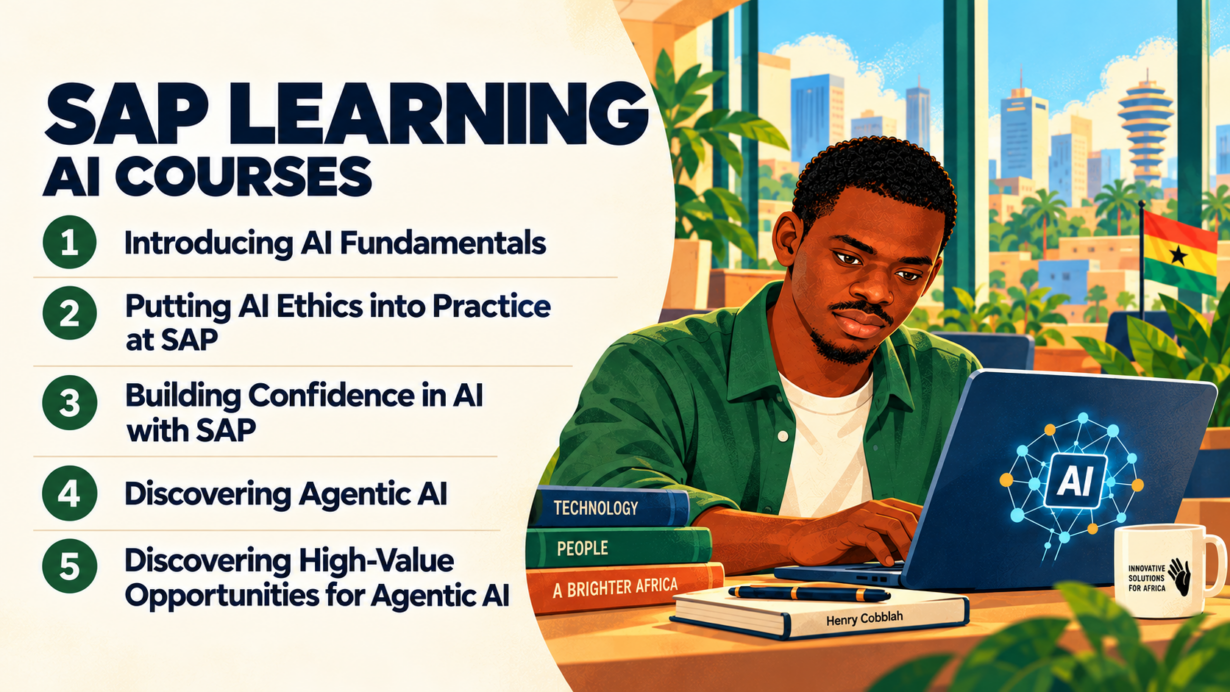
Together, these SAP AI learning topics form a progression: understand the basics, consider ethics, build informed confidence, explore agentic AI, and evaluate where it may deliver value. The goal is not to become an AI expert overnight. It is to develop the judgment needed to use AI thoughtfully in real business situations.